Beehaw - technology publisher
-
Uber hit with a nearly $1 billion fine for automatically deactivating drivers in Europe
submitted by sanitation to technologybeehaw.org
63 points | 9 comments
https://www.engadget.com/2242192/uber-hit-with-1-billion-fine-for-automatically-deactivating-drivers-in-europe/?amp%3Butm_campaign=Echobox-Engadget&%3Butm_medium=Social-Distribution&%3Butm_source=Twitter -
Chinese humanoid robots smash human records in 100m sprint and high jump at Beijing robot games
submitted by themachinestops to technologybeehaw.org
11 points | 2 comments
https://apnews.com/article/china-humanoid-robot-games-us-86cb8e310843151a77057e4cb764b4e2cross-posted from: lemmy.dbzer0.com/post/74402441
-
Take-Two files subpoenas asking Microsoft and Discord for records in hunt for GTA 6 leaker
submitted by sanitation to technologybeehaw.org
30 points | 2 comments
https://www.videogameschronicle.com/news/take-two-files-subpoenas-to-microsoft-and-discord-in-hunt-for-gta-6-leaker/ -
U.S. warns Siemens devices can be hacked amid fears Iran is breaching water plants
submitted by sanitation to technologybeehaw.org
34 points | 5 comments
https://www.cnbc.com/2026/08/19/us-cybersecurity-siemens-devices-hacked-iran-war.html -
ASML stands for Advanced Semiconductor Materials and Laser, and was an American company, so when did it become a French company?
beehaw.org -
One In Five Drivers Switches Off The Safety Tech Meant To Save Their Lives
submitted by sanitation to technologybeehaw.org
45 points | 28 comments
https://www.carscoops.com/2026/08/unused-car-features-study/ -
[Technology Connections] My water heater is cooler than yours
submitted by p03locke to technologybeehaw.org
85 points | 17 comments
https://www.youtube.com/watch?v=F_7B2shTPPU -
‘They’re thinking about the likes’: deadly TikTok motorway trend horrifies Ireland
submitted by sanitation to technologybeehaw.org
15 points | 2 comments
https://www.theguardian.com/media/2026/aug/22/deadly-tiktok-motorway-driving-trend-horrifies-ireland -
Even Claude Is in the Dark About Dario Amodei’s Wife—and Her Influence at Anthropic
submitted by themachinestops to technologybeehaw.org
6 points | 0 comments
https://www.wsj.com/tech/ai/claude-dario-amodei-wife-anthropic-e1eeda7dcross-posted from: lemmy.dbzer0.com/post/74378168
Cami Clark—who started what she called a ‘revolutionary porn company’ where she sought investment from Jeffrey Epstein—keeps a low profile but is a key adviser to the AI chief. Its coming IPO could top trillions.

-
Texas A&M physics prof writes: In ten years, light diffused by satellites will erase the the stars for the vast majority of humans. Save the night sky now.
submitted by sanitation to technologybeehaw.org
25 points | 0 comments
https://www.houstonchronicle.com/opinion/outlook/article/satellites-night-sky-stars-22397123.php?amp%3Butm_medium=copy-url-link&%3Butm_campaign=article-share&%3Bhash=aHR0cHM6Ly93d3cuaG91c3RvbmNocm9uaWNsZS5jb20vb3Bpbmlvbi9vdXRsb29rL2FydGljbGUvc2F0ZWxsaXRlcy1uaWdodC1za3ktc3RhcnMtMjIzOTcxMjMucGhw&%3Btime=MTc4NzM0NDA4MzI3NA%3D%3D&%3Brid=OTAwMzBiZWUtODdhOS00NzI4LTllOGUtNjg1MmM0MGMzNDRm&%3Bsharecount=NQ%3D%3D -
The Politics of Cyberdecks: Why women around the world are building their own DIY computers.
submitted by alyaza to technologybeehaw.org
39 points | 3 comments
https://conversationalist.org/2026/08/20/cyberdecks-politics-diy-computers-technology-tiktok-annike-tan-big-tech-electronics-waste-upcycling/In March of this year, TikTok creator Annike Tan started learning about cyberdecks from YouTube. Usually designed for a specific purpose, a cyberdeck is a custom-built mini computer, often in a maximalist, cyberpunk aesthetic that contrasts with the factory-made, minimalist look of traditional, mass-produced technology. […]
[…] In a world where artificial intelligence is being pushed in every industry, and data centers are being built without the knowledge or input of their neighbors, creating a device for under the radar, specific offline use—rather than one designed for overreliance, addiction, and overconsumption—is a clever way to fight back.
For many builders, cyberdecks are also an opportunity to repurpose electronic waste. According to the World Health Organization, there was an estimated 62 million tons of e-waste produced globally in 2022 alone, and only 22% of that waste was formally collected and recycled. Experts argue that much of this electronic waste can be repurposed into new builds—though there isn’t much data on the subject since currently, very little e-waste is collected for recycling, thus impeding proper disposal. Learning how to build a cyberdeck from old devices can teach people about the value of each of its parts, what makes a device run, and which parts can still be functional rather than thrown into a landfill.
“Making cyberdecks educates people’s minds about technology,” says Giovanna Aguiar, a cyberdeck builder based in São Paulo, Brazil, known as @gio.yaml on TikTok and Instagram. In May, Aguiar, a trained programmer, noticed a gap in the digital cyberdeck community: most tutorials were in English and many of the necessary components were cost-prohibitive for people living in Brazil. Now, Aguiar makes content in Portuguese that teaches people how to refurbish their electronic waste instead of buying new parts, in order to create something completely new. “From the moment you create a cyberdeck with an old laptop that isn’t turning on, for example, you start to understand that that laptop is just a group of parts,” she says. An old device’s webcam can be disconnected and used separately, as can its screen. “You start seeing old electronics as objects with potential, and long-term, I think that can change the world,” she continues. “For me, sustainability is very connected to cyberdecks.”
-
Meta's $1.4 Trillion Reckoning: Can Infinite Scroll Be Illegal? - Gadget Review
submitted by sanitation to technologybeehaw.org
28 points | 1 comments
https://www.gadgetreview.com/metas-1-4-trillion-reckoning-can-infinite-scroll-be-illegal -
Nintendo Wipes Out 400+ Switch Emulator Repos in Single-Day GitHub Sweep * TorrentFreak
submitted by themachinestops to technologybeehaw.org
32 points | 2 comments
https://torrentfreak.com/nintendo-wipes-out-400-switch-emulator-repos-in-single-day-github-sweep/cross-posted from: lemmy.dbzer0.com/post/74356500
-
TikTok reaches $400 million settlement with US Justice Department over children’s privacy
submitted by sanitation to technologybeehaw.org
14 points | 2 comments
https://www.sun-sentinel.com/2026/08/21/tiktok-reaches-400-million-settlement-with-us-justice-department-over-childrens-privacy/ -
Tesla’s Robotaxi gets caught crashing through bollards, just as it readies the purpose-built Cybercab for public roads
submitted by sanitation to technologybeehaw.org
56 points | 7 comments
https://www.techradar.com/vehicle-tech/hybrid-electric-vehicles/teslas-robotaxi-gets-caught-crashing-through-bollards-just-as-it-readies-the-purpose-built-cybercab-for-public-roads -
China joins Europe in scrapping Windows for Linux
submitted by sanitation to technologybeehaw.org
53 points | 2 comments
https://www.zdnet.com/article/china-drops-windows-for-linux/ -
The Dutch Data Protection Authority has decided to fine Uber €825 million ($966 million) under European data protection rules for deactivating driver accounts through automated systems without adequa…
submitted by sanitation to technologybeehaw.org
35 points | 0 comments
https://www.reuters.com/world/dutch-regulator-fines-uber-966-million-automating-driver-suspensions-document-2026-08-21/Full title: The Dutch Data Protection Authority has decided to fine Uber €825 million ($966 million) under European data protection rules for deactivating driver accounts through automated systems without adequately informing them
-
What it looks like to live next to a sprawling data center
submitted by LuckyDevil to technologybeehaw.org
32 points | 3 comments
https://www.usatoday.com/picture-gallery/tech/2026/08/19/data-center-communities-controversy-photos/91372086007/See how towering data centers transform neighborhoods and landscapes.
-
Silicon Valley Executives Are Tech Fans. Just Not for Their Own Kids.
submitted by alyaza to technologybeehaw.org
26 points | 0 comments
https://www.nytimes.com/2026/08/18/technology/silicon-valley-tech-fans-children.html?unlocked_article_code=1.6VA.lKFj.DijwrbLexEr-On Tuesday, opening statements begin in Oakland, Calif., for the latest social media trial. California and other states have brought a case against Meta, owner of Facebook and Instagram, saying the company “harnessed powerful and unprecedented technologies to entice, engage and ultimately ensnare youth and teens.”
Meta denies the allegations. But you know who else has some issues with social media, screen time and the addictive nature of devices? Quite a few of the tech executives in Silicon Valley, at least when it comes to their own households.
“I don’t generally want my kids to be sitting in front of a TV or computer for a long period of time,” Mark Zuckerberg, Meta’s chief executive, once said. Interacting with people is good, but passively consuming content — “just going from video to video” — was not associated with “the same positive benefits,” he explained.
When Mr. Zuckerberg’s second child was born in 2017, he and his wife, Priscilla Chan, wrote in an open letter to her that “it’s important to make time to go outside and play.” Smelling flowers got a shout-out. So did picking up leaves. Nothing digital rated a mention.
Tech executives like Mr. Zuckerberg don’t talk about their own families often. When they do, however, they usually make clear their wariness of tech. For their children, tech does not play the same role it does for the rest of society: teacher, babysitter, all-purpose distraction and, increasingly, constant companion. It seems barely there at all.
-
The Shape of Apps
submitted by alyaza to technologybeehaw.org
17 points | 2 comments
https://parakeet.co/blog/the-shape-of-apps/While icons on iOS (formerly iPhoneOS) have always been rounded squares, and rounded-square icons have existed on Apple platforms for over 20 years now, Mac app icons have historically exhibited a variety of unique silhouettes, which helped identification alongside other visual tools like color, lighting, and dimensionality.
Because app icons from the Mac OS X era are so beloved, it’s very understandable—relatable even—how mandating rounded square app icons is downright heartbreaking to long-time Mac OS X users.
What happened? Why did this happen? And what should we do?
-
Stripe Buys A.I. Start-Up OpenRouter for $7.5 Billion
submitted by sanitation to technologybeehaw.org
20 points | 3 comments
https://www.nytimes.com/2026/08/19/business/stripe-openrouter-ai.html?unlocked_article_code=1.7FA.0nQj.V0ZYa4THYwkz&%3Bsmid=url-share -
Fooling Flock: The Car Wrap That Blinds Plate Cameras
submitted by sanitation to technologybeehaw.org
17 points | 1 comments
https://autos.yahoo.com/policy-and-environment/articles/fooling-flock-car-wrap-blinds-171300990.html -
Quantum Computer Solves a Problem in 15 Minutes That Classical Methods Can’t Practically Compute
submitted by sanitation to technologybeehaw.org
25 points | 2 comments
https://scitechdaily.com/quantum-computer-solves-a-problem-in-15-minutes-that-classical-methods-cant-practically-compute/ -
Is Vine back? Short-form video-sharing app Divine opens to public
submitted by remington to technologybeehaw.org
38 points | 20 comments
https://www.bbc.com/news/articles/c3r05g378w4o -
Phone and OS Recommendations
submitted by its_me_xiphos to technologybeehaw.org
25 points | 21 commentsI’m a complete and utter newbie to this. But, based on the discussion about “not needing a new phone” and the availability of alternatives in Canada, can anyone recommend what might act as a suitable alternative to Android and iPhone OS. Ideally, I can keep my phone and just use a different OS. But I have some problems and could use some foundational knowledge to start my research and make a decision:
- I’m trying to keep my Samsung S21 Ultra as long as possible. I looked at Graphene and Lineage and both do not support it from what I can tell.
- Internet, heavy data use is not an issue. I have wi-fi wherever I go.
- I’d prefer not to buy a new phone. If I need to buy a used phone, I am leaning towards an older Pixel and Graphene OS. Is that a sound decision? If not, are there phones such as Fairphone (not in Canada…) to consider?
-
Amazon aims for delivery drones to reach 500 US neighborhoods by end of 2026
submitted by alyaza to technologybeehaw.org
32 points | 5 comments
https://arstechnica.com/gadgets/2026/08/amazon-aims-for-delivery-drones-to-reach-500-us-neighborhoods-by-end-of-2026/Amazon wants to grow its Prime Air delivery drone service sixfold to reach nearly 500 cities and towns across the United States by the end of 2026. The planned expansions from Amazon and its rivals could make the convenience of delivery drone services available to tens of millions more people in the coming months—but will also test more communities’ tolerance for increased noise from daily drone flights.
On August 19, Amazon announced it would soon launch Prime Air in the metropolitan areas of Chicago; Cleveland; Atlanta; Syracuse, New York; and Boise, Idaho, with more to come later in the year. Each Prime Air site offers delivery drone service within an area of about 175 square miles, with delivery times ranging from half an hour to an hour.
Prime Air already operates out of Amazon warehouses in 10 cities across seven states. Those include primarily suburban neighborhoods of Phoenix; Tampa; Kansas City; Omaha, Nebraska; Baton Rouge, Louisiana; Detroit; Houston; and San Antonio, Dallas, and Waco, Texas.
-
Best Buy 'repairs' customer's gaming laptop by simply removing half the RAM— claims unit in question only accepts 32 GB of RAM despite listing a 64GB configuration
submitted by themachinestops to technologybeehaw.org
1 points | 0 comments
https://www.tomshardware.com/pc-components/ram/best-buy-repairs-customers-gaming-laptop-by-simply-removing-half-the-ram-claims-unit-in-question-only-accepts-32gb-ram-of-ram-despite-selling-it-as-a-64gb-configurationcross-posted from: lemmy.dbzer0.com/post/74241477
-
LLMs and Humans are Cognitive Cousins – Sean Carroll podcast w/Dr. Chandra Sripada
submitted by nymnympseudonym to technologybeehaw.org
9 points | 20 comments
https://preposterousuniverse.com/podcast/2026/08/10/363-chandra-sripada-on-how-llms-and-humans-are-cognitive-cousins/Do LLMs “think” in a similar way to humans? Or is it totally different?
Maybe it’s a good idea to listen to someone who publishes papers on this very subject, and is a professor of both philosophy and psychiatry and directs an Institute for Cognitive Science. That person is Dr. Chandra Sripada and his insights are fascinating.
Sean Carroll (interviewer, scientist and science communicator) says this interview made him lean towards the answer being “yes, they think like humans” whereas previously he favored the opposite view.
-
Carissa Véliz, author, "Prophecy" | Techtonic with Mark Hurst on WFMU
submitted by obbeel to technologybeehaw.org
9 points | 0 comments
https://techtonic.fm/episodes/2026-07-20-carissa-veliz-author-prophecy/In centuries past, predictions of the future came from oracles and seers. Today they come from tech oligarchs and their predictive AI systems, fed by mass surveillance. Carissa Véliz returns to Techtonic to discuss her book “Prophecy” about “prediction, power, and the fight for the future.”
Carissa Véliz discusses Mass Surveillance and its use on prediction analysis. It’s from July but it is a good listen
-
There's No Reason to Buy a New Phone Anymore
submitted by Powderhorn to technologybeehaw.org
111 points | 45 comments
https://www.theatlantic.com/technology/2026/08/secondhand-tech-boom/688309/In a time when an iPhone can be preordered, customized, and on its way to your doorstep all through a touch-screen tap, it’s almost quaint to remember that people used to camp out for smartphone releases. That was once the regular routine of Andrew Erickson, a longtime tech YouTuber, who recalled to me with a mixture of nostalgia and awe the time he braved the rain at 4:30 a.m. to join a line for the newest iPhone. The line snaked through the mall, nearly reaching the parking lot.
Next month, when Apple is expected to launch the iPhone 18 Pro, Erickson has no plans to even buy the phone, let alone fight crowds for it. Instead, along with a growing number of Americans, Erickson is buying used. He’s fed up with incremental improvements in gadgets, he told me, and is more interested in getting an old version of the iPhone 17 Pro when it hits the secondhand market at a discount. Already, almost half of his current devices were acquired secondhand, and as electronics prices soar amid an AI-fueled chip shortage, he expects that portion to grow. “The argument’s just getting weaker and weaker to buy brand-new,” he said.
Based on the numbers, old tech products are indeed being looked at in a new light. Globally, the size of the industry could reach $153.4 billion this year, up from $104.1 billion four years ago. The used-smartphone market alone is expected to grow by more than 12 percent in 2026, according to the International Data Corporation, which forecasts that the market for new smartphones will experience a record drop this year. Growth in secondhand electronics and refurbished gadgets that have been restored to full working condition now outpaces that of new products on eBay, the e-commerce giant reports.
-
A Finnish town is heating itself with 2,000 tonnes of crushed rock: its giant “sand battery” can cover almost a month of heating demand and has cut district heating emissions by 70%
submitted by remington to technologybeehaw.org
103 points | 11 comments
https://www.cnbc.com/2026/07/25/finland-sand-battery-renewable-energy-storage.html -
IP can’t save you from AI
submitted by chicken to technologybeehaw.org
40 points | 7 comments
https://pluralistic.net/2026/08/18/enron-corpus/By demanding the copyright our bosses love, we’re seeking the right to be angry about AI, even as the AI companies and our bosses cut deals to train chatbots with our work, which they will use to attack our livelihoods.
-
Democracy v the machine: the birth of the digital age and the warnings that were ignored
submitted by Powderhorn to technologybeehaw.org
18 points | 0 comments
https://www.theguardian.com/news/2026/aug/18/the-long-read-democracy-v-the-machine-digital-age-warnings-computer-history-technologyOne of the stranger things about this dizzying, headlong moment in time is that it doesn’t have much of a past. Everything is about the future of this, the future of that: the future of work, the future of humanity, the future of the planet. It’s as if everyone is screaming (some ecstatically, most terror-stricken): robots are taking over the world! Meanwhile, you can’t put down your phone, unplug, delete your AI apps, tell Zoom to piss off; it feels as if you are racing toward something, and can’t stop, or look back, or think straight.
But of course this weird moment in history does have a past. It comes from somewhere. It wasn’t inevitable. Things could have turned out differently. They still can. And if you look back, one thing you’ll see is that a lot of people saw this all coming. They foresaw our present when it was still the future. They thought it might turn out fabulously, a computer utopia. And they worried it might turn out disastrously. Above all, they issued warning after warning about the rise of what I call the artificial state, the replacement of the liberal democratic nation-state, the consent of the governed, with the rule of people by machines. They warned of a future in which democratic deliberation would be replaced by prediction by calculation, the public sphere would be supplanted by data-driven commerce, and drones would take the place of the demos. Why didn’t anyone listen?
-
The Diamond Industry’s Old Guard Wants You to Buy ‘Natural’
submitted by Powderhorn to technologybeehaw.org
20 points | 4 comments
https://bloom.bg/4i9Ztu4Diamonds are among the most ancient, alien substances on the planet. They’re older than dinosaurs, older than plants. Diamonds were born back when the world resembled Mordor: a collection of angry volcanos, spewing gases and minerals into an atmosphere filled with lightning and methane clouds. Bits of carbon were trapped deep in the Earth’s mantle, then subjected to billions of years of unimaginable heat and pressure. This process transformed them into one of the hardest known substances — and one of the most precious. All the gem-quality diamonds ever found would fit inside a double-decker bus.
At least, they would have 20 years ago. These days, you can grow one in about a week, for the price of a breakfast burrito.
“I’ll show you what scares the diamond industry,” says Edahn Golan, co-founder of Tenoris LLC, a jewelry industry consulting and data analytics company. “When I meet with these executives, and they ask me, ‘How far can the price of diamonds fall?’ I show them this.” He gestures toward his laptop screen, which displays a walmart.com listing for a pair of half-carat diamond studs about the size of two lentils. Price: $12.
Companies whose diamond supply relies on digging are putting on a brave face. “If people can buy a pair of $12 lab-grown diamond earrings from Walmart, I feel nothing but delight,” says Al Cook, chief executive officer of De Beers Group. “It means you can buy something that looks beautiful for a very low price. I applaud Walmart. That has very little to do with our business.”
-
Mozilla’s CTO thinks AI should be built like the internet
submitted by alyaza to technologybeehaw.org
37 points | 17 comments
https://restofworld.org/2026/open-source-ai-infrastructure-mozilla/For decades, Mozilla has been one of the strongest advocates for an open internet. Today, as artificial intelligence becomes increasingly central to how businesses and governments operate, the organization is making a similar case for open AI.
In a report published last month, Mozilla, a free software community and nonprofit project, said the performance gap between top open-source models and proprietary systems like Claude and ChatGPT has narrowed to just 3%. The report highlighted the growing popularity of open models, noting that in February 2026, Alibaba’s open-source model Qwen was downloaded more times than the next eight models combined.
The debate over open AI has gained fresh momentum after Meta released a new open-weight model on August 10, and promised more would come soon.
Raffi Krikorian, Mozilla’s chief technology officer, believes organizations need alternatives to proprietary AI systems to gain greater control over their data and infrastructure.
-
We Tracked a Shipment of Rare Books. It Ended at an Amazon AI Training Facility
submitted by themachinestops to technologybeehaw.org
48 points | 1 comments
https://www.404media.co/we-tracked-a-shipment-of-rare-books-it-ended-at-an-amazon-ai-training-facilitycross-posted from: lemmy.dbzer0.com/post/74144681
A 404 Media investigation was able to reveal Amazon’s book buying operation, which hasn’t been previously reported, by placing a tracking device in a rare book we suspected would be acquired by an AI company for training data, and following it around the country to its final destination. That final destination was an Amazon warehouse in Las Vegas, Nevada. Amazon employees who work at this location say all they do is receive massive shipments of printed books which they then cut the bindings off in order to scan the books more quickly. The printed book is destroyed in the process. The logo of the Amazon team that works at this warehouse, called VGT3, is a dinosaur, brandishing its teeth and with a book in its hands. “Amazon purchases books through commercial channels to help develop and improve the products and services our customers use,” an Amazon spokesperson told me in a statement. The world’s AI companies are constantly looking for, and spending extreme resources to locate, more material to train their AI models. With books, that sometimes means destroying them in the process, something that large parts of the public have spoken up against, and which we can now confirm Amazon is doing. In July, I published a story about booksellers who reported a historical spike in sales starting in the past year. They suspected this spike in sales was due to AI companies acquiring any books they can in search of new training data. Printed books are valuable as training data because a lot of the text they contain is not readily available on the internet, which AI companies have already scraped. The data is also conveniently organized and, if the book was printed before 2022, is guaranteed to be free of AI-generated text, which can make any AI model that is trained on it worse via a recursive process called “model collapse.” 📖 Do you know work at a facility where you scan books? I would love to hear from you. Using a non-work device, you can message me securely on Signal at @emanuel.404. Otherwise, send me an email at emanuel@404media.co. These booksellers suspected AI companies were behind these large bulk purchases because of the high number of books they were buying, the seemingly random choice of books, and the fact that these buyers, unlike libraries and universities, did not seem price sensitive at all. But booksellers couldn’t say for certain who was behind the large purchases because the marketplaces where they sell their books keep the buyers anonymous. When an order comes in, a bookseller ships the sold books to a warehouse operated by the marketplaces, where books are sorted and then sent to the buyer. In July, one bookseller told me they received a very large order of around 1,000 books on Biblio, one of these marketplaces. The seller agreed to put an Apple AirTag provided by 404 Media in one of the books included in this order so we could see where the book was going. And by extension, which company, AI or otherwise, was behind this massive order. 404 Media granted the bookseller anonymity because they worried sharing this information would harm their business. Biblio did not respond to a request for comment.
-
Unwinding the Great Tech Power Grab
submitted by alyaza to technologybeehaw.org
13 points | 1 comments
https://rebeccawilliams.info/unwinding-the-great-tech-power-grab/Movements to reclaim power over technology are springing up, from Neo-Luddism to Permacomputing to Rewilding the Internet. Alongside these approaches, we must discuss how tech has atrophied the exact civic muscle we’ll need to reclaim power over it.
Last month, I had the pleasure of attending the Summer of Ludd, organized by NYC Off Tech and dedicated to getting people “off big tech, into public space, and re-enchanting each other.” Like the original Luddites rebelling against the machinery that stole their livelihoods, the Neo-Luddites are correct to rebel against today’s tech, which threatens our livelihoods, our privacy, our living world, our creative joy, and our ability to think.
Despite the heaviness of the stakes, the event itself was light: plays, puppets, clown workshops—I put on a gnome hat. My favorite moment of the event, which I dipped in and out of all week, was when a yellow gnome asked me to put my iPhone away and “carry this instead,” then passed me a hand-painted cardboard apple attached to a popsicle stick. How silly; how reasonable.
By itself, the event was not a labor movement; it was a cultural one. I think often about the divide between Abbie Hoffman and Tom Hayden as depicted in Aaron Sorkin’s The Trial of the Chicago 7. Abbie keeps insisting on the importance of cultural revolution through street demonstrations, theater, humor, and sexual liberation, while Tom dismisses it as a distraction from “actual revolution.” My favorite moment in the film comes when Abbie tells him, “We’re not going to jail because of what we did, we’re going to jail because of who we are. Think about that the next time you shrug off cultural revolution.”
I agree with Abbie: how people play, feel free, and come to see what’s possible matters just as much as formal politics. I also agree with Naomi Klein when she says surrealism expands our political imagination, and with David Graeber when he asks, What’s the Point If We Can’t Have Fun? My coalition is big enough for whimsy, and it can’t be effective without it.
-
First test flight of largest all-electric aircraft used just $5 of electricity
submitted by alyaza to technologybeehaw.org
54 points | 16 comments
https://arstechnica.com/gadgets/2026/08/first-test-flight-of-largest-all-electric-aircraft-used-just-5-of-electricity/The test flight of Heart Aerospace’s X1 demonstrator aircraft took place at Plattsburgh International Airport in upstate New York on August 12. The X1 aircraft is comparable in size to a small regional airliner and can achieve a maximum takeoff weight exceeding 25,000 pounds with the help of four wing-mounted electric motors. The battery-electric propulsion system delivered more than one megawatt of power during the maiden flight.
All-electric aircraft can offer quieter and cleaner flight without the emissions that come from burning jet fuel. They may also prove more reliably cost-effective than conventional aircraft that come with jet fuel costs subject to geopolitical disruptions.
But the initial success of the X1 demonstrator does not mean Heart Aerospace is planning to commercialize an all-electric aircraft. Current battery-electric systems can only typically sustain short flights of about 100 to 200 miles, which is why they have been limited to air taxi operations by companies such as Joby and Archer.
Instead, testing of the X1 and a planned follow-on X2 aircraft will shape development of Heart Aerospace’s main offering to the airline industry—a 30-seat hybrid-electric regional airliner known as the ES-30.
-
CME Group and Silicon Data to Launch Compute Futures on October 5 to Unlock New Way to Hedge AI Risks
submitted by themachinestops to technologybeehaw.org
3 points | 0 comments
https://www.cmegroup.com/media-room/press-releases/2026/8/11/cme_group_and_silicondatatolaunchcomputefuturesonoctober5tounloc.htmlcross-posted from: lemmy.dbzer0.com/post/74091518
CME Group, the world’s leading derivatives marketplace, and Silicon Data, the industry leader in GPU market intelligence and benchmarking backed by global trading firm DRW, today announced plans to launch two Compute futures contracts on October 5, 2026, pending regulatory review.
These innovative new trading tools will bring much-needed hedging and investment vehicles to businesses looking to manage the cost of compute, the processing power and hardware infrastructure that machines need to train and run AI models. Both Silicon Data H100 Rental Index Futures and Silicon Data B200 Rental Index Futures will track indexes measuring hourly rental GPU costs published by Silicon Data. Each contract will represent a month’s worth of rent for the Nvidia H100, the chip central to today’s AI ecosystem, and the next-generation Nvidia Blackwell B200, respectively.
“Compute has become the currency of the AI age, and this innovative market will bring transparency to the current and future costs that AI builders and hyperscalers need to hedge as they grow,” said Pete Keavey, Global Head of Energy and Environmental Products at CME Group. “Just as oil fueled the 20th century economy and evolved from spot trading into a global derivatives market, our futures contracts will now turn compute into a standardized, tradable commodity that will provide global businesses with a reliable, regulated venue to manage price risk .”
“For years, two companies buying the exact same GPU capacity could pay wildly different prices with no way to know who got the better deal. They will now have a benchmark to check that against,” said Carmen Li, Chief Executive Officer of Silicon Data. “Compute futures give the market something it’s never had: a public, tradable reference price for the resource every AI system runs on. Silicon Data’s benchmarks make that price real; CME makes it tradable. Together, that turns compute from something enterprises negotiate blindly into a market they can actually plan around.”
Explosive demand has driven sharp swings in compute prices, with volatility exposing a gap in the risk-management toolkit for companies building the AI infrastructure. CME Group and Silicon Data’s Compute futures close that gap, bringing transparency to the market and allowing companies, including AI developers and hyperscalers, to lock in their costs. They will also provide a window into future AI spending.
-
New website lets drivers check whether their license plate has been searched on Flock database
submitted by VetOfTheSeas to technologybeehaw.org
25 points | 6 comments
https://www.dexerto.com/entertainment/new-website-lets-drivers-check-whether-their-license-plate-has-been-searched-on-flock-database-3398804/ -
How ICE's Surveillance System Works
submitted by along_the_road to technologybeehaw.org
12 points | 0 comments
https://www.youtube.com/watch?v=aRUhgrqnpGY -
PBS station fears losing 50TB of data after being ghosted by cloud storage provider
submitted by Powderhorn to technologybeehaw.org
22 points | 5 comments
https://arstechnica.com/information-technology/2026/08/pbs-station-fears-losing-50tb-of-data-after-being-ghosted-by-cloud-storage-provider/After its cloud storage provider went defunct, a PBS affiliate decided to sue a data center provider to regain access to 50TB of TV shows, videos, and other data dating back 70 years.
As reported this week by Current, a trade newspaper covering public broadcasting, St. Louis affiliate Nine PBS filed a lawsuit against Iron Mountain Data Centers on July 28, seeking access to the data. In the litigation filed in Denver District Court, Nine PBS says that its cloud storage provider, Open Source Storage (OSS), used one of Iron Mountain’s Denver data centers to store the channel’s data. However, OSS is being unresponsive, and Nine PBS says Iron Mountain has refused to release its data.
The data in question includes the station’s coverage of the COVID-19 pandemic, East St. Louis’ history, The Great Flood of 1993, and over 11,000 files, The Denver Post reported in July. The lawsuit claims that “most” of the data is “unique and irreplaceable,” according to the Post.
Last month, a judge blocked Iron Mountain from deleting or modifying the data.
In a hearing on Wednesday, a judge ruled that Iron Mountain must hand over any physical devices holding the data, Current reported today. The judge also said that Nine PBS must find a third party, such as a former OSS worker, who can help retrieve the data within 30 days and without sharing or corrupting data belonging to other OSS clients.
Nine PBS is already communicating with a former OSS employee “who is willing to help,” the report said. If complications arise, such as from the data being encrypted, another hearing will be scheduled. Nine PBS and Iron Mountain must provide updates by September 14.
-
Firefox is now the last major browser that still supports uBlock Origin
submitted by remington to technologybeehaw.org
42 points | 7 comments
https://www.pcworld.com/article/3212428/firefox-is-now-the-last-major-browser-that-still-supports-ublock-origin.html -
Sign of the Times: An Account of the First Tech Workers’ Strike
submitted by alyaza to technologybeehaw.org
13 points | 0 comments
https://longhaulmag.com/first-tech-workers-strike/Tech workers at The New York Times began to organize in 2018. The campaign to form a union originated in a conversation between two workers, Kathy Zhang and Goran Svorcan-Merola, and proceeded underground through 2019 and into 2020, moving cautiously from one person to the next. In the summer of 2020, however, amid the uprising following the police murder of George Floyd, the Times solicited and published an op-ed by Republican senator, Tom Cotton, calling for the deployment of the National Guard to suppress protestors in New York. A number of Black journalists risked their employment by speaking out publicly in protest. In solidarity, hundreds of employees from across many departments of the Times walked off the job.
The motion and solidarity generated by that action gave tech workers the momentum to go public with our union drive. We reached a majority of support in tech departments by the spring of 2021. It is difficult to imagine that we would have reached this stage in the absence of the walkout. It was an early lesson in the importance of both methodical, committed organizing and a willingness to shift course in moments of upsurge, without guarantees, a lesson only imperfectly remembered when we struck in 2024.
Despite Times management’s fierce anti-union campaign, we won union recognition in spring 2022, with a landslide 82 percent vote in favor. The more than 700 engineers, designers, data scientists and analysts, product managers, and project managers who make up our union include everyone who works on the Times’s website and mobile apps, digital products widely understood to be essential to the Times’s unique financial success among news companies.
In striking, we discovered the intransigence of management and new strength of our own. We reclaimed our values from our employer, and we learned how our power as workers is made: When we take action, we build capacity for action.
-
‘I feel like I’m at war’: are we losing the battle against machine-made music?
submitted by Powderhorn to technologybeehaw.org
22 points | 1 comments
https://www.theguardian.com/music/ng-interactive/2026/aug/13/ai-musicThis year, the battle for song of the summer has been eclipsed by a much more complicated – some would even say disturbing – debate. That’s because we find ourselves asking not “What’s the song of the summer?” but rather “Is the song of the summer even real?”
Among the top contenders for the title is Fenix Flexin’s Rubberz, a single released in June that has ascended to No 58 on the Billboard Hot 100 and racked up more than 35m Spotify streams. It’s not the sort of fare Fenix usually cooks up. The artist is known for his trap music as part of the rap duo Shoreline Mafia, but Rubberz is a mildly noirish, 80s-inspired synth-pop track featuring a voice nothing like his. The song has drawn comparisons to Morrissey, but it more closely resembles Men at Work’s Down Under, or a Weird Al Yankovic parody of Men at Work. It’s pretty awful. But more importantly, it has an uncanny quality to it. It sounds off.
Almost immediately after it came out, skeptics accused Fenix of employing artificial intelligence to create the track, if not entirely at least partly. He and the song’s credited producer, Purps on the Beat, initially denied it, with Fenix insisting that he’d just used Auto-Tune and a phoney British accent. The kerfuffle culminated this month when indie DJ-producer Medasin posted a video that he said proved that Rubberz had been made using the free generative music tool Treblo.
Medasin then captured himself giving Treblo prompts to pump out his own track. Its sound and lyrics were eerily close to those of Rubberz. Fenix rejected Medasin’s claims, posting what he said were clips of the song’s stems, or its fundamental components, but then Medasin posted a rebuttal of him demonstrating how AI songs, too, can be broken down into stems. A few days later, Fenix finally admitted to using AI to make Rubberz, writing: “never said I didn’t use AI, i said it had nun to do w recording process.”
-
BMW’s in-car Spider-Man ad is a warning sign: we were promised a transport revolution, instead we got cars tracking us and serving us ads
submitted by spit_evil_olive_tips to technologybeehaw.org
210 points | 28 comments
https://disconnect.blog/bmws-in-car-spider-man-ad-is-a-warning-sign/ -
AdGuard promises to keep filtering Facebook ads
submitted by XLE to technology
207 points | 39 comments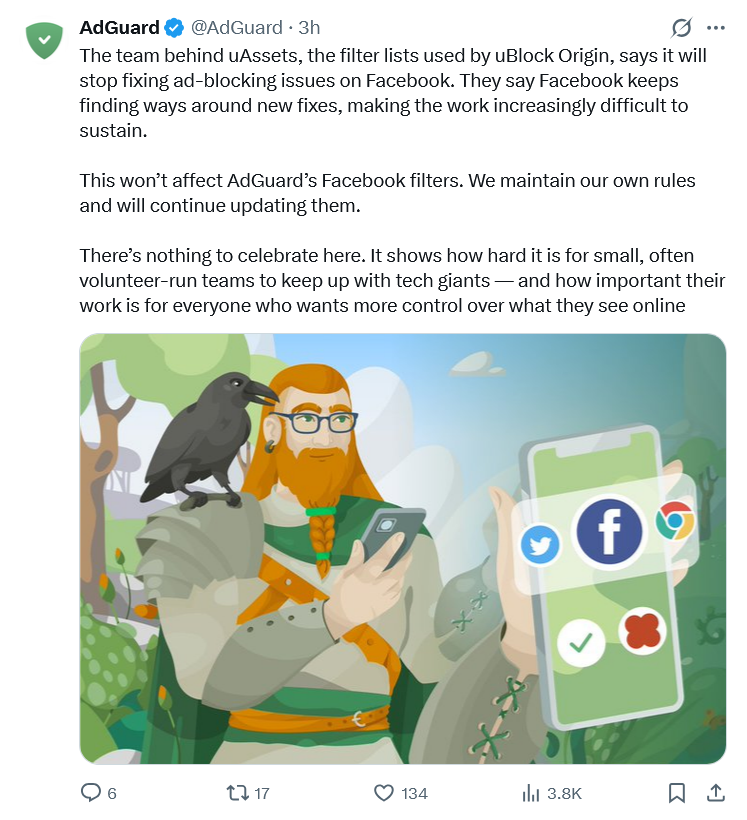
From xcancel:
The team behind uAssets, the filter lists used by uBlock Origin, says it will stop fixing ad-blocking issues on Facebook. They say Facebook keeps finding ways around new fixes, making the work increasingly difficult to sustain.
This won’t affect AdGuard’s Facebook filters. We maintain our own rules and will continue updating them.
There’s nothing to celebrate here. It shows how hard it is for small, often volunteer-run teams to keep up with tech giants — and how important their work is for everyone who wants more control over what they see online
uBlock Origin offers some AdGuard rule sets, so I don’t know exactly what this means for existing uBO users.
beehaw.org -
‘Nightmare fodder’: Roku’s AI slop channel is even worse than expected
submitted by Powderhorn to technologybeehaw.org
55 points | 7 comments
https://www.theguardian.com/tv-and-radio/2026/aug/12/roku-ai-slop-fairground-creator-tv-channelThe appeal of Roku is that, whatever you happen to want to watch, there will almost certainly be a live channel for it. Just want to watch Little House on the Prairie? There’s a channel for it. Just want to watch Duck Dynasty? There’s a channel for that too. Purely want to watch nothing but local news from Wisconsin? Guess what: there’s a channel for that too.
But despite this wealth, a section of the population was still to see its needs fulfilled. What about people who hate plot and vision and the sight of people speaking convincing dialogue that synchronises perfectly with the movement of their lips? What about the people who just want to watch an unyielding torrent of eerily weightless nightmare fodder? Well, good news. Roku has finally caught up.
It was reported last week that Roku launched the Fairground AI Creator TV channel, the first free, all-AI streaming channel that pulls content from roughly 100 AI creators around the world. Early reactions were, to put it mildly, not great. The Verge compared it to eating from a trough, while Futurism called it “bottom-of-the-barrel slop”.
In truth, you will not watch Fairground AI Creator TV, and that’s sort of the point. This is television with vanishingly low production costs. Compare an hour of this cheap slop with, say, the tens of millions of dollars it takes to produce an episode of Stranger Things, and you’ll soon understand why executives might find the prospect irresistible. In this landscape you don’t need breakout hits, just enough stoned and curious students at 3am to turn a profit.
That said, I have actually just spent a few hours watching Fairground AI Creator TV, more out of self-hatred than anything else, and it would appear that the early reviews are right. On the plus side, the channel is evidence that artificial intelligence has come on in leaps and bounds over the last couple of years. Had this been attempted in 2023, we would have had a 24/7 feed of mutant Will Smith choking down handfuls of writhing spaghetti, and everyone would have vomited themselves dry. Generally speaking, what Fairground has to offer is much better.
However, it is still awful. Categorically, catastrophically awful. The channel doesn’t so much offer shows as a drifting dreamscape of bad ideas rendered as horribly as possible with no thought paid to scheduling. At one point on Wednesday, a shrill high-frequency anime gave way to a long and staid German-language short about Nazi bureaucracy. After that came a sort of Gladiator ripoff that had all the dynamism of an exhibit you’d see at the fourth-best museum on a poorly planned family holiday.
-
Judge rules Meta caused "public nuisance" and must fund mental health treatment
submitted by remington to technologybeehaw.org
93 points | 4 comments
https://arstechnica.com/tech-policy/2026/08/meta-ordered-to-pay-567m-to-treat-youth-mental-health-problems-it-helped-create/A New Mexico judge yesterday ordered Meta to pay $567 million for a fund that would alleviate the “public nuisance” created by its social media services. The order to pay for youth mental health care is in addition to $375 million in civil penalties that a jury ordered Meta to pay earlier in the same case.
-
If you feel like you’re drowning in tasks, this one platform is the only reason I’m getting 4 hours of my day back.
submitted by Laurakey to technologybeehaw.org
1 points | 4 comments
https://utiliqpro.com/Utiliq Pro is a Digital Productivity Ecosystem, delivering innovative digital tools, combining AI & Non-Ai powered solutions, plus productivity technologies that help individuals, creators, professionals, businesses, developers, and organizations work smarter, save time, and achieve more. Our goal is to simplify digital work, accelerate productivity, and drive digital transformation across Africa and the world.